Why Regular Drone Maintenance Can Extend Your Drone's Lifespan
Most drone owners pay close attention to their drone when it's in the air.
They monitor battery levels, check camera settings, watch flight paths, and carefully plan each mission.
Yet surprisingly, many overlook what happens between flights.
The reality is that a drone's lifespan isn't determined solely by how often it flies. It's also determined by how well it's maintained when it's not flying.
Just like a car that needs regular servicing or a camera that requires proper care, drones perform best when maintenance becomes part of the ownership routine rather than something that's only considered after a problem appears.
Whether you use your drone for aerial photography, surveying, agriculture, inspections, mapping, or recreational flying, regular maintenance can help protect your investment, improve reliability, and significantly extend the life of your aircraft.
Drones may look lightweight and effortless in the sky, but a lot is happening behind the scenes.
Every flight places stress on multiple components.
Motors spin at thousands of revolutions per minute. Propellers continuously cut through the air. Batteries undergo charging and discharging cycles. Sensors constantly collect and process information to keep the aircraft stable.
Most of this wear isn't visible immediately.
Instead, it accumulates gradually over time.
This is why many drone-related issues seem to appear unexpectedly when, in reality, they have been developing slowly over dozens or even hundreds of flights.
One of the most common mistakes drone owners make is assuming that a minor issue can wait until later.
Perhaps a propeller has a small chip.
Maybe the drone has started vibrating slightly more than usual.
Or perhaps flight times have decreased a little.
Individually, these issues may not seem serious.
However, small problems often place additional stress on other components.
A damaged propeller can force motors to work harder. Battery issues can affect overall flight performance. Poor sensor calibration can reduce navigation accuracy.
What begins as a minor concern can eventually result in expensive repairs, operational downtime, or even a crash.
Routine maintenance helps catch these problems early when they are typically easier and less expensive to resolve.
If there is one component that deserves extra attention, it's the battery.
Drone batteries are among the most critical and expensive parts of any aircraft.
They also have a limited lifespan.
Improper charging habits, exposure to high temperatures, over-discharging, and poor storage practices can all accelerate battery degradation.
A healthy battery contributes to:
- Consistent flight performance
- Reliable power delivery
- Longer flight times
- Improved safety
- Reduced risk of unexpected power loss
Regular inspections can help identify warning signs such as swelling, damaged connectors, or declining performance before they become serious problems.
For commercial operators, battery maintenance isn't just good practice—it's essential for mission reliability.
Many people think maintenance is only about preventing failures.
In reality, it also improves everyday performance.
A properly maintained drone often feels noticeably different in the air.
Pilots may experience:
- Smoother flight characteristics
- Improved stability
- Better GPS performance
- More accurate positioning
- Consistent camera results
- Reduced vibration
For professionals working in surveying, inspections, agriculture, mapping, or content creation, these performance improvements can directly affect the quality of their work.
Modern drones are sophisticated systems packed with advanced technology.
Inside a typical drone, you'll find components such as:
- Flight controllers
- GPS modules
- Cameras
- Gimbals
- Obstacle avoidance sensors
- Vision systems
- Communication modules
Replacing these components can be expensive.
Regular inspections help ensure they remain clean, properly calibrated, and functioning as intended.
In many cases, a simple maintenance check can prevent damage that would otherwise require major repairs.
Professional drone operators rarely wait for something to go wrong.
Instead, they treat maintenance as part of normal operations.
There's a reason for this approach.
When a drone becomes unavailable unexpectedly, the impact extends beyond repair costs.
It can lead to:
- Delayed projects
- Missed deadlines
- Reduced productivity
- Lost revenue
- Client dissatisfaction
For businesses that depend on drones, reliability is often just as important as capability.
Regular maintenance helps ensure equipment remains ready when it's needed most.
You don't need to be a technician to perform basic inspections.
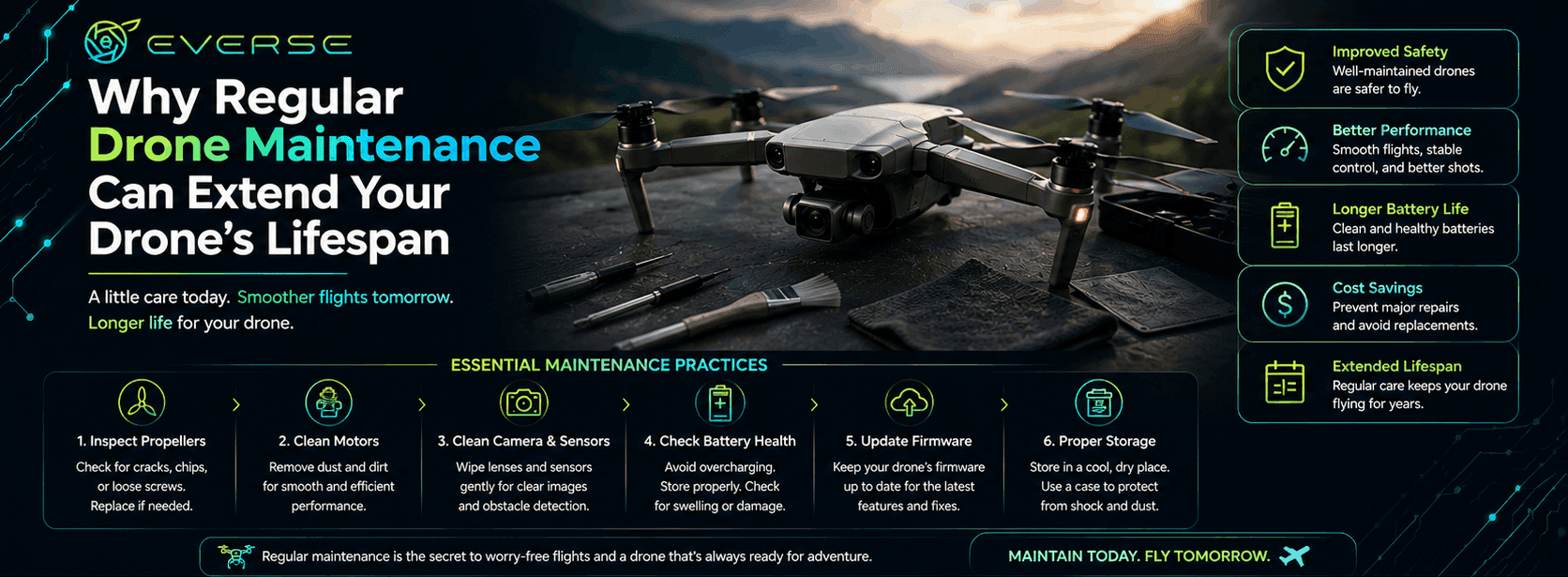
Before and after flights, consider checking:
Look for cracks, chips, bends, or signs of excessive wear.
Listen for unusual sounds and ensure they rotate smoothly.
Inspect for swelling, physical damage, or charging abnormalities.
Check for cracks, loose screws, or structural damage.
Keep lenses and sensors clean and free from dust or debris.
Install updates that improve system performance, reliability, and safety.
Developing these habits takes only a few minutes but can help prevent much larger problems down the road.
Some drone owners view maintenance as an unnecessary expense.
In reality, it's often one of the most cost-effective investments they can make.
Replacing a worn propeller, tightening loose hardware, or recalibrating sensors typically costs far less than repairing damage caused by component failure.
Preventive maintenance reduces the likelihood of major breakdowns while helping extend the life of critical systems.
Over the long term, this can significantly lower overall ownership costs.
At Everse, we work with drone operators across a variety of industries and understand the importance of keeping equipment flight-ready.
Our drone maintenance and repair services are designed to help identify issues before they become costly problems.
From routine inspections and diagnostics to component repairs and system checks, our team helps ensure that drones continue operating safely, efficiently, and reliably.
Whether you're flying for recreation or running commercial missions, proactive maintenance can make a significant difference to both performance and equipment lifespan.
There is no magic formula for extending a drone's lifespan.
The secret is consistency.
Regular inspections. Proper battery care. Timely repairs. Clean equipment. Updated firmware.
These simple habits may not seem significant individually, but together they have a major impact on reliability and longevity.
The drones that remain dependable year after year are rarely the ones that receive the least attention.
They're the ones that receive the most care.
Because when it comes to protecting your drone investment, maintenance isn't just about avoiding problems—it's about ensuring every flight is as safe, reliable, and productive as possible.