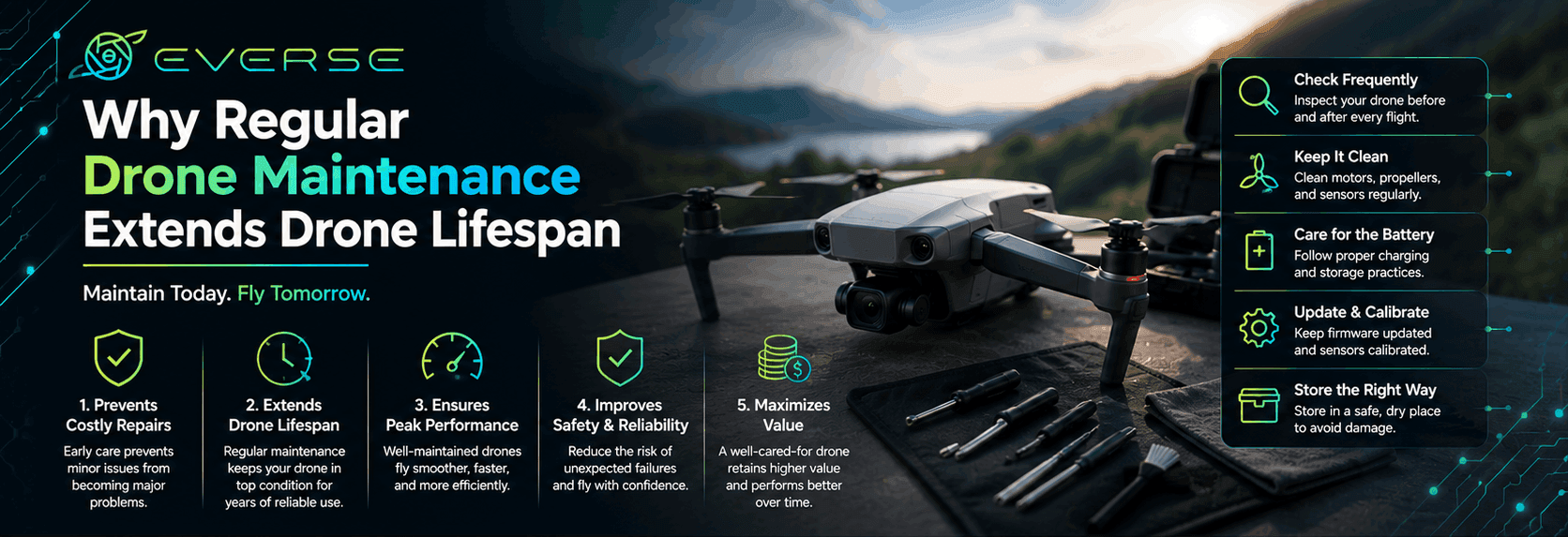
Why Regular Drone Maintenance Extends Drone Lifespan
For many drone owners, maintenance is something that only becomes a priority when a problem appears.
The drone starts vibrating unexpectedly. Flight times begin to decrease. Error messages appear more frequently. Or worse, the aircraft experiences a failure during an important mission.
By that stage, what could have been a simple maintenance task often becomes a costly repair.
Whether you're a recreational pilot, content creator, surveyor, agricultural operator, or commercial drone service provider, your drone is a valuable piece of equipment. Like any advanced machine, it performs best when it receives regular care and attention.
The reality is simple: drones that are maintained properly tend to last longer, perform more reliably, and require fewer expensive repairs over their lifetime.
At first glance, a drone may appear to be a simple flying device.
In reality, every flight places multiple components under significant stress.
During operation:
- Motors rotate at extremely high speeds
- Propellers endure continuous aerodynamic forces
- Batteries experience repeated charging and discharging cycles
- Sensors collect and process data constantly
- Electronic systems manage flight stability in real time
Over hundreds of flights, this wear gradually accumulates.
Without regular inspections and maintenance, small issues can develop into major failures that affect both performance and safety.
One of the biggest advantages of routine maintenance is early problem detection.
Many drone failures don't happen suddenly.
Instead, they begin as minor issues such as:
- Slight propeller damage
- Loose screws
- Motor wear
- Battery degradation
- Sensor calibration drift
- Dust or debris buildup
Individually, these issues may seem insignificant.
However, when ignored, they can affect flight stability, reduce efficiency, and increase stress on other components.
Routine maintenance helps identify these warning signs before they result in costly repairs or unexpected downtime.
The battery is one of the most important and expensive components of any drone.
It is also one of the most commonly neglected.
Improper charging habits, extreme temperatures, and poor storage practices can significantly reduce battery lifespan.
Regular battery inspections help identify:
- Swelling
- Physical damage
- Performance degradation
- Charging abnormalities
- Connector wear
Maintaining battery health not only improves flight performance but also reduces the risk of in-flight power failures.
For commercial operators, battery maintenance is essential for maintaining operational reliability.
Many pilots assume that maintenance is only about preventing breakdowns.
In reality, it also improves performance.
A well-maintained drone typically delivers:
- More stable flights
- Improved maneuverability
- Better GPS accuracy
- More reliable sensor performance
- Consistent camera results
- Longer component lifespan
These improvements become particularly important for professional applications such as surveying, inspections, mapping, agriculture, and aerial photography where precision matters.
Modern drones contain sophisticated technology.
Components such as:
- Flight controllers
- Cameras
- Gimbals
- GPS modules
- Vision sensors
- Obstacle avoidance systems
represent a significant portion of the drone's overall value.
Regular inspections help ensure these systems remain in optimal condition.
Protecting these components through preventive maintenance is often far less expensive than replacing them after a failure occurs.
For businesses that rely on drones, maintenance isn't simply about protecting equipment.
It's about protecting operations.
A drone that becomes unavailable due to unexpected repairs can cause:
- Project delays
- Reduced productivity
- Missed deadlines
- Increased operating costs
- Customer dissatisfaction
Regular maintenance helps minimize these risks by improving reliability and reducing the likelihood of unexpected failures.
This is why professional drone operators often follow structured maintenance schedules rather than waiting for issues to appear.
Routine drone maintenance doesn't always require major repairs.
Simple inspections can make a significant difference.
Key areas to monitor include:
Inspect for cracks, chips, bends, and excessive wear.
Check for unusual sounds, vibration, overheating, or resistance during rotation.
Monitor charging behavior, physical condition, and overall performance.
Look for cracks, loose components, and signs of structural stress.
Ensure sensors remain clean and free from dust or debris.
Keep software and firmware updated to maintain optimal performance and system stability.
Developing a consistent maintenance routine helps identify potential issues before they affect operations.
Many drone owners postpone maintenance because they view it as an unnecessary expense.
However, preventive maintenance is almost always more affordable than major repairs.
Replacing a worn propeller, tightening loose components, or recalibrating sensors typically costs far less than repairing damage caused by a preventable failure.
In many cases, regular maintenance can extend the life of critical components by months or even years.
Over time, this significantly reduces total ownership costs.
At Everse, we understand that reliable drones are essential for both recreational and professional operations.
Our drone maintenance and repair services are designed to help operators maximize equipment performance, reduce downtime, and extend the lifespan of their drones.
From routine inspections and diagnostics to repairs and component replacements, our experienced technicians help identify issues before they become costly problems.
Whether you're operating a drone for photography, surveying, agriculture, inspections, or commercial projects, proactive maintenance can help ensure your equipment remains mission-ready.
Every drone owner wants the same thing: reliable performance and maximum value from their investment.
The good news is that extending a drone's lifespan doesn't require complicated procedures.
It starts with consistency.
Regular inspections, proper battery care, timely repairs, software updates, and preventive maintenance all contribute to better performance and longer equipment life.
The drones that last the longest aren't necessarily the most expensive.
They're often the ones that receive the most attention.
Because when it comes to drone ownership, maintenance isn't just about fixing problems—it's about preventing them before they ever leave the ground.