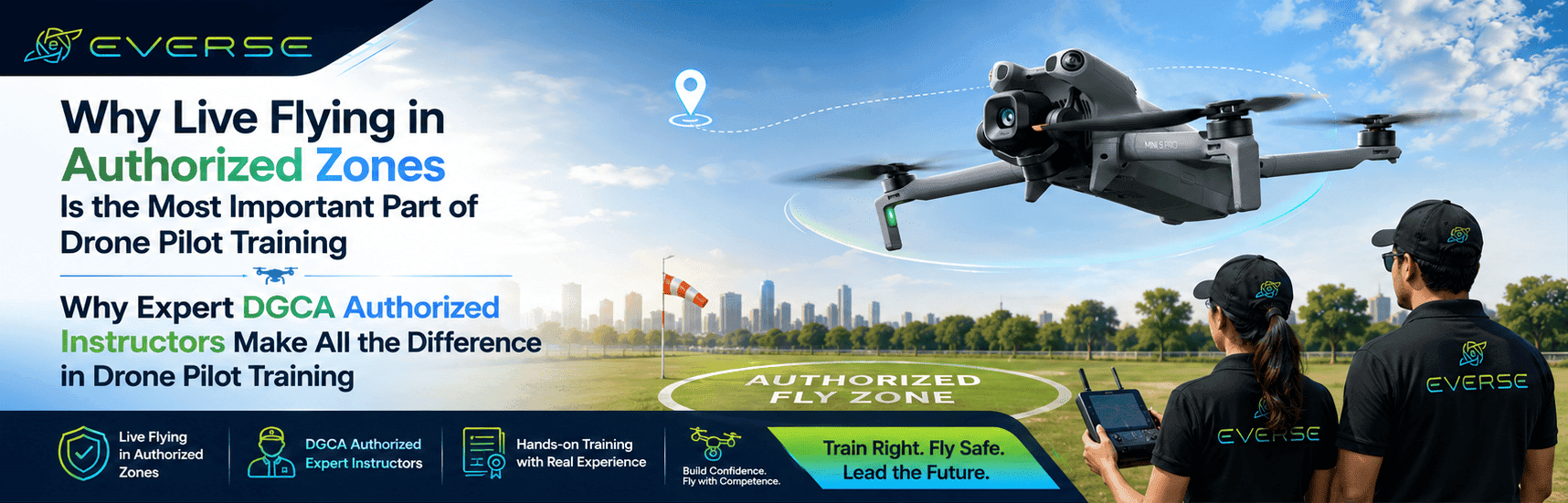
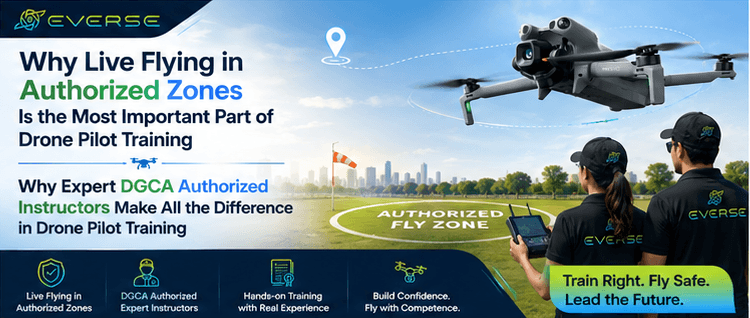
Why Live Flying in Authorized Zones Is the Most Important Part of Drone Pilot Training
Ask any experienced drone pilot what helped them learn the most during training, and you'll rarely hear "the classroom."
While understanding regulations, airspace rules, and flight planning is essential, nothing compares to the experience of actually flying a drone in a real-world environment.
The moment a trainee lifts a drone off the ground for the first time, theory begins to transform into practical skill. The controls become meaningful, safety procedures start making sense, and confidence gradually replaces uncertainty.
This is why live flight training in authorized flying zones is one of the most valuable components of any professional drone pilot program.
At Everse, we believe that great drone pilots are built through hands-on experience. That's why our DGCA Approved Drone Pilot Training Program places significant emphasis on practical flying sessions conducted in authorized zones designed for safe and structured learning.
Many aspiring drone pilots spend hours watching videos, reading articles, and learning about drone technology online.
While these resources are useful, they can only take a learner so far.
Understanding how a drone works is very different from actually operating one.
For example:
- Reading about takeoffs is different from executing one smoothly.
- Learning about wind conditions is different from experiencing them during flight.
- Studying emergency procedures is different from responding calmly when something unexpected happens.
Professional drone operations require practical decision-making, situational awareness, and confidence under real conditions.
These skills can only be developed through actual flying experience.
Drone training isn't simply about finding an open field and taking off.
Professional flight training should take place in authorized environments where operations can be conducted safely and in compliance with regulations.
Authorized flying zones provide trainees with:
- A controlled learning environment
- Adequate safety measures
- Professional supervision
- Structured flight exercises
- Reduced operational risks
- Exposure to real-world flight procedures
Most importantly, trainees learn how professional drone operations are conducted in accordance with established aviation practices.
For aspiring pilots, this creates habits and operational discipline that remain valuable throughout their careers.
One of the biggest challenges new drone pilots face is confidence.
Many trainees initially worry about:
- Losing control of the aircraft
- Making navigation errors
- Managing takeoffs and landings
- Flying in changing weather conditions
- Handling unexpected situations
These concerns are completely normal.
The solution isn't more theory. The solution is guided practice.
Every successful flight helps trainees become more comfortable with the aircraft and more confident in their abilities.
Over time, basic maneuvers become second nature, allowing pilots to focus on mission objectives rather than simply controlling the drone.
This progression is one of the most rewarding parts of professional drone training.
Live flight training goes far beyond simply keeping a drone in the air.
Under instructor supervision, trainees learn how to perform the same types of procedures used in professional operations.
Training exercises often include:
Before every mission, pilots must ensure that equipment, batteries, weather conditions, and operational requirements are suitable for flight.
Developing this discipline is critical for safe operations.
Safe takeoffs and landings form the foundation of drone flying.
Pilots learn how to maintain control during the most important phases of flight while following established safety practices.
Hovering may appear simple from the ground, but maintaining stable positioning requires concentration and control.
These exercises help pilots develop precision and confidence.
Pilots learn how to execute controlled movements, directional changes, and mission-specific flight patterns.
These skills become increasingly important during surveying, inspections, mapping, and industrial applications.
Unexpected situations can occur during any flight.
Practical training helps pilots understand how to respond calmly and effectively while prioritizing safety.
As drone adoption expands across industries, employers are increasingly looking beyond certification alone.
Organizations want pilots who can demonstrate practical competence.
A candidate who has completed extensive live flight training often enters the workforce with:
- Greater operational confidence
- Better safety awareness
- Improved decision-making skills
- Stronger understanding of real-world flight conditions
- Greater readiness for professional missions
In industries such as surveying, construction, agriculture, infrastructure inspection, and mining, practical flying experience can be just as valuable as theoretical knowledge.
At Everse, we recognize that becoming a professional drone pilot requires more than passing an examination.
It requires experience.
Our 5-Day DGCA Approved Drone Pilot Training Program combines classroom learning with extensive practical flight training conducted in authorized flying zones.
Participants receive opportunities to:
- Apply theoretical knowledge in real flight scenarios
- Build confidence through guided practice
- Learn professional operating procedures
- Develop safe flying habits
- Gain hands-on experience under expert supervision
This practical approach helps bridge the gap between learning about drones and operating them professionally.
Every skilled drone pilot remembers their first successful flight.
It's the moment when drone technology stops being something they study and becomes something they can confidently control.
While regulations, safety procedures, and aviation knowledge remain essential parts of training, practical flight experience is where true pilot development happens.
Live flying in authorized zones gives trainees the opportunity to learn, practice, make mistakes, improve, and ultimately become competent drone operators.
For anyone serious about building a future in the drone industry, there is no substitute for hands-on flying experience.
And at Everse, that's exactly what we aim to provide—an environment where aspiring pilots can move beyond theory and begin their journey as confident, capable, and industry-ready drone professionals.