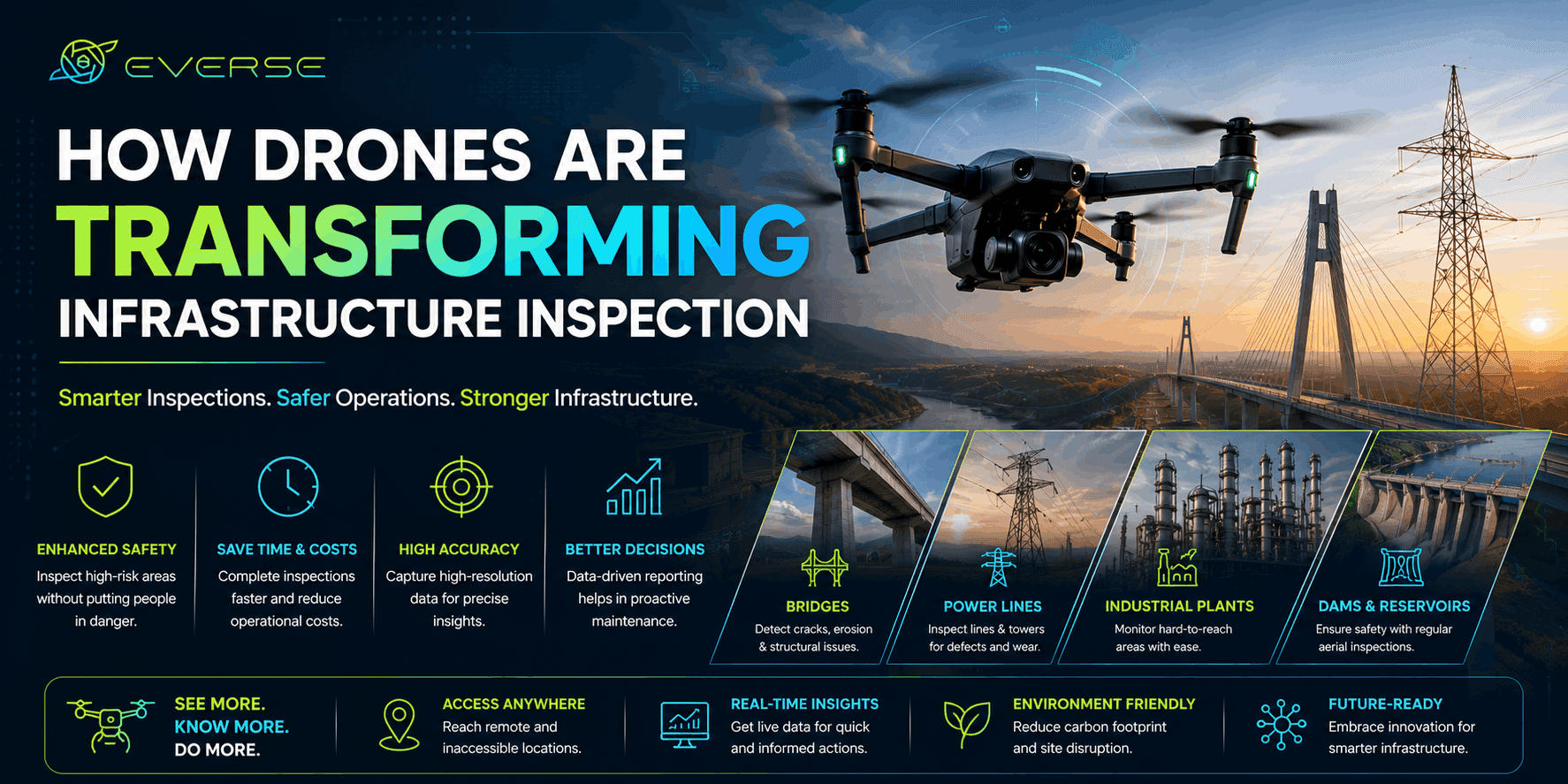
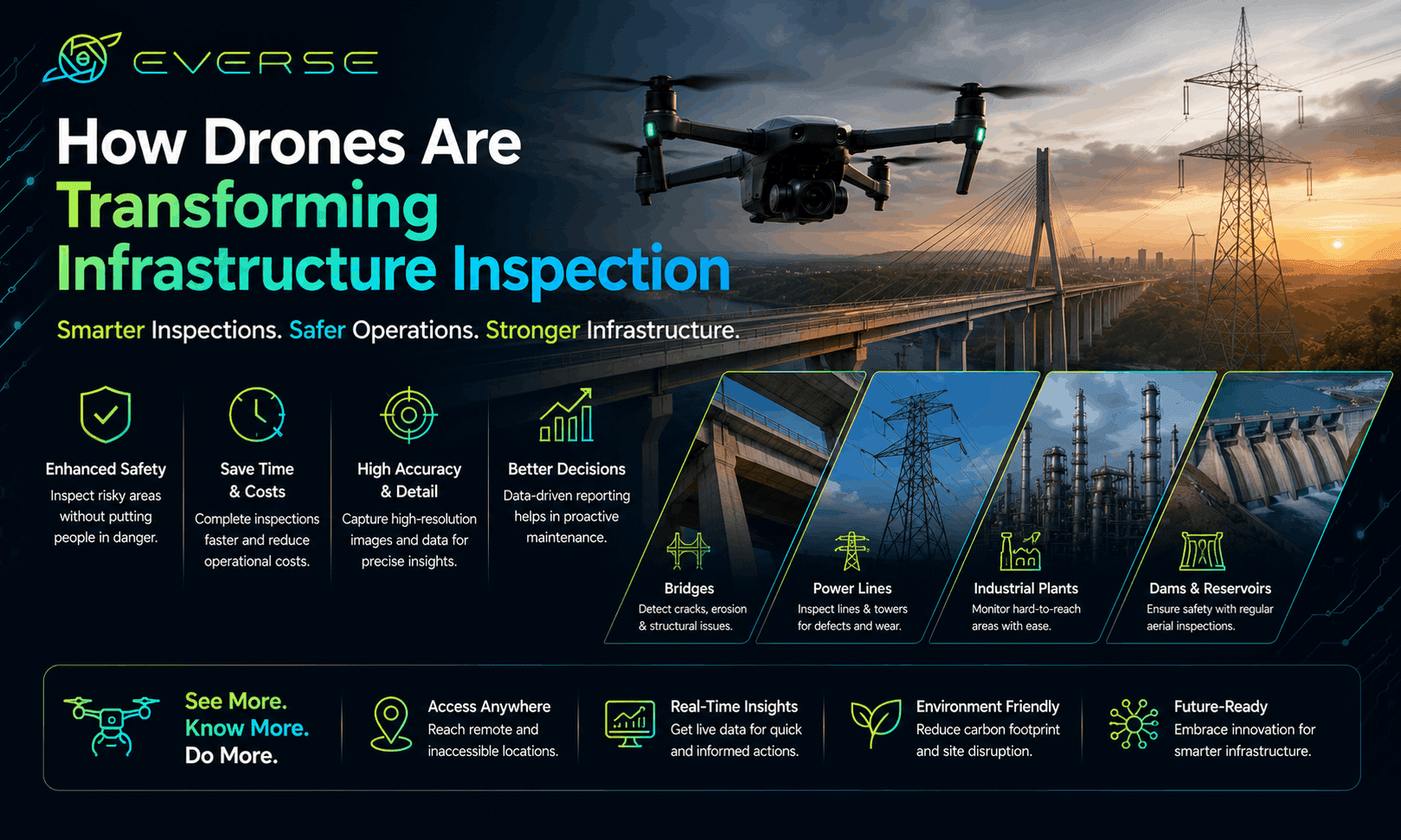
How Drones Are Transforming Infrastructure Inspection
Inspecting infrastructure has never been a simple task.
Whether it's a bridge stretching across a river, a high-voltage transmission tower, a wind turbine, or the roof of a large industrial facility, inspections have traditionally required significant time, manpower, specialized equipment, and careful planning. In many cases, they also involve considerable safety risks for the people performing the work.
Today, that process is changing.
Commercial drones have emerged as one of the most valuable tools for infrastructure inspection, enabling engineers, utility companies, construction firms, and government agencies to collect accurate data faster, safer, and more efficiently than ever before.
Rather than replacing inspectors, drones are helping professionals work smarter by providing detailed aerial insights that were once difficult, expensive, or dangerous to obtain.
Infrastructure inspection is essential for identifying wear, damage, and potential safety concerns before they become serious problems.
However, conventional inspection methods often involve:
- Working at significant heights
- Using scaffolding or cranes
- Temporarily closing roads or facilities
- Long inspection times
- High labor costs
- Increased safety risks
For large structures, even a routine inspection can take several days and require multiple teams working together.
In industries where downtime is expensive, these challenges can have a direct impact on productivity and operational costs.
Modern inspection drones are equipped with high-resolution cameras, advanced sensors, GPS systems, and intelligent flight software.
Instead of sending people into hazardous environments, operators can fly drones close to structures while capturing detailed images and videos from multiple angles.
This allows inspection teams to gather valuable information without interrupting normal operations in many situations.
The result is a faster, safer, and more efficient inspection process.
One of the biggest advantages of drone-based inspections is improved worker safety.
Many infrastructure inspections require technicians to climb towers, inspect elevated structures, or access confined and hazardous spaces.
By using drones, inspectors can evaluate many of these areas remotely.
This significantly reduces exposure to risks such as:
- Falls from height
- Electrical hazards
- Difficult terrain
- Unstable structures
- Harsh environmental conditions
Keeping workers out of dangerous situations while still collecting high-quality inspection data is one of the primary reasons organizations are adopting drone technology.
Speed matters.
Whether inspecting hundreds of utility poles or evaluating a large industrial site, drones can cover extensive areas in a relatively short period.
Compared to traditional inspection methods, drones help organizations:
- Complete inspections faster
- Reduce project timelines
- Minimize operational disruptions
- Increase inspection frequency
This allows maintenance teams to identify issues earlier and respond more quickly when repairs are needed.
Modern commercial drones can capture incredibly detailed imagery.
High-resolution cameras allow inspectors to identify:
- Surface cracks
- Corrosion
- Loose components
- Structural damage
- Water intrusion
- Material deterioration
Because the captured data is digital, teams can review images multiple times, compare historical inspections, and monitor structural changes over time.
This improves documentation and supports more informed maintenance decisions.
Drone inspections are now common across a wide range of industries.
Engineers use drones to inspect bridge decks, support structures, expansion joints, and difficult-to-reach areas without disrupting traffic for extended periods.
Utility companies inspect transmission towers, power lines, substations, and electrical infrastructure more safely and efficiently.
Construction teams monitor structural progress, identify quality issues, and document project milestones from the air.
Technicians use drones to inspect turbine blades, towers, and mechanical components while reducing the need for hazardous climbing operations.
Large industrial plants, storage tanks, pipelines, and refineries can be inspected with minimal disruption to ongoing operations.
Communication towers and antenna systems are routinely inspected using drones to identify damage, loose equipment, or maintenance requirements.
Modern inspection drones do much more than capture photographs.
Depending on the application, drones can also carry specialized payloads such as:
- Thermal imaging cameras
- LiDAR systems
- Multispectral sensors
- Zoom cameras
- Gas detection sensors
These technologies help inspectors detect problems that may not be visible to the naked eye.
For example, thermal cameras can identify overheating electrical components, while LiDAR creates highly accurate 3D models of structures and surrounding environments.
This additional data allows organizations to make better-informed maintenance decisions.
Infrastructure inspections are necessary, but they can also be expensive.
Hiring cranes, scaffolding, specialized access equipment, and large inspection teams quickly increases project costs.
Drones help reduce many of these expenses while maintaining high-quality inspection standards.
Organizations benefit from:
- Lower equipment costs
- Reduced labor requirements
- Faster project completion
- Fewer operational interruptions
- Improved inspection efficiency
Over time, these savings can make drone inspections an increasingly valuable investment.
While drone technology is becoming more advanced, successful inspections still depend on skilled operators.
Commercial inspection pilots need to understand:
- Safe flight planning
- Aviation regulations
- Risk assessment
- Data collection techniques
- Equipment operation
- Inspection workflows
Proper training helps ensure inspections are performed safely, legally, and effectively.
As drone adoption continues to grow across industries, qualified drone pilots are becoming increasingly valuable in infrastructure, utilities, engineering, and industrial services.
Infrastructure is the backbone of modern society.
Keeping bridges, power lines, communication towers, industrial facilities, and transportation networks in good condition requires accurate and timely inspections.
Drone technology is making that responsibility easier to manage.
By improving safety, increasing efficiency, reducing costs, and providing richer inspection data, drones are helping organizations maintain critical infrastructure with greater confidence than ever before.
At Everse, we believe commercial drone technology is creating new opportunities across industries. Through DGCA-approved drone pilot training and advanced drone solutions, we aim to prepare professionals with the skills needed to support the future of infrastructure inspection and many other high-growth applications.
As industries continue to embrace aerial technology, drones are proving that some of the best ways to inspect the world are from above.