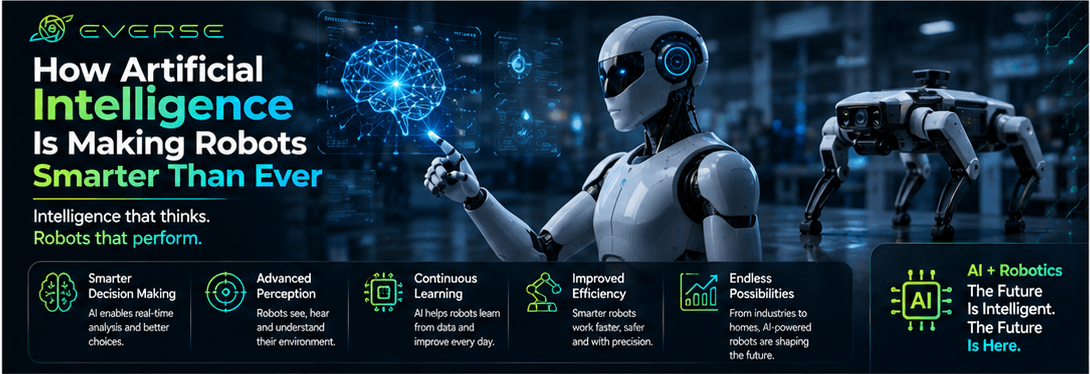
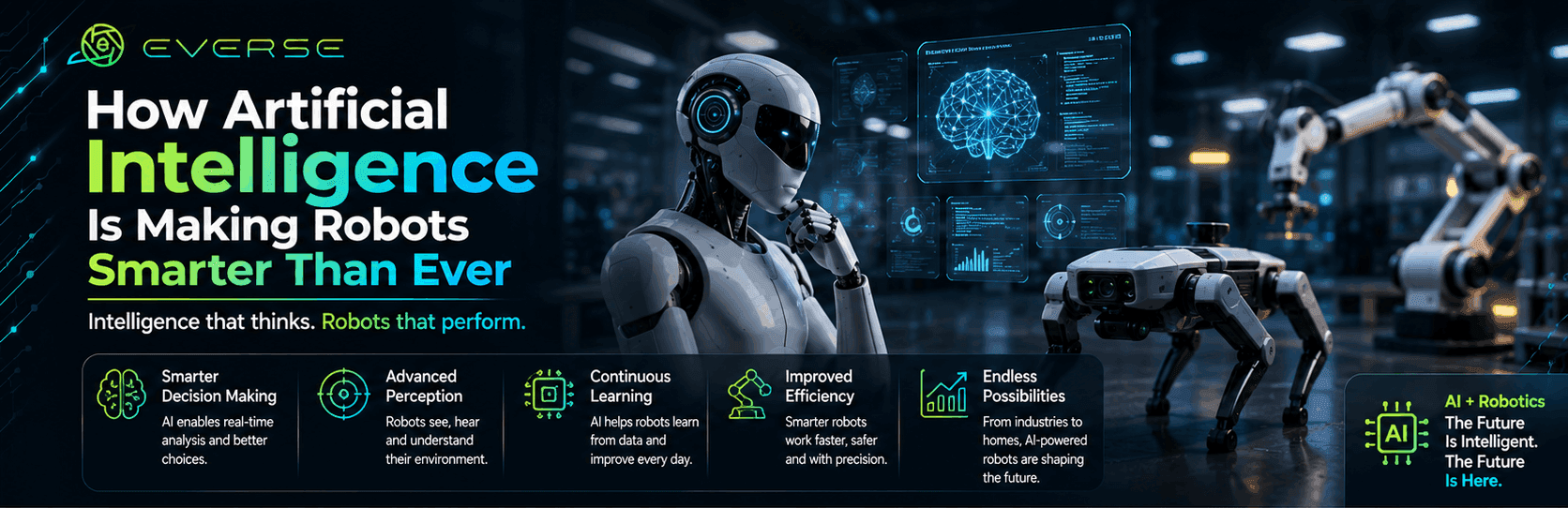
How Artificial Intelligence Is Making Robots Smarter Than Ever
Not long ago, robots were designed to perform the same task over and over again.
A robotic arm on a manufacturing line would repeat identical movements with incredible speed and precision. Warehouse robots would follow predefined paths. Cleaning robots would move according to simple programmed rules.
These machines were efficient, but they weren't intelligent.
Today, robotics has entered a new era.
Thanks to rapid advances in Artificial Intelligence (AI), robots are no longer limited to following fixed instructions. They can analyze their surroundings, recognize people and objects, make decisions, learn from data, and adapt to changing environments.
This combination of robotics and AI is transforming industries and redefining what machines are capable of achieving.
Traditional robots operate based on pre-programmed instructions.
If every condition remains the same, they perform exceptionally well.
However, the real world is rarely predictable.
People move unexpectedly. Objects change position. Lighting conditions vary. Environments evolve.
Artificial Intelligence gives robots the ability to interpret these changing conditions instead of simply reacting to predefined commands.
Rather than asking, "What instruction should I follow?"
AI-enabled robots ask, "What is happening around me, and what should I do next?"
That shift is what makes modern robotics so powerful.
Before a robot can make decisions, it first needs to understand the world around it.
To achieve this, robots combine information from multiple sensors, including:
- Cameras
- Depth sensors
- LiDAR
- Ultrasonic sensors
- Infrared sensors
- GPS
- Microphones
- Inertial Measurement Units (IMUs)
Each sensor captures different types of information.
Artificial Intelligence processes this data in real time, allowing robots to build an understanding of their surroundings.
For example, an autonomous robot may detect an obstacle, identify whether it is moving, calculate a safe path around it, and continue its task without human intervention.
One of the biggest breakthroughs in robotics is computer vision.
Using AI-powered image recognition, robots can identify:
- People
- Vehicles
- Animals
- Products
- Road signs
- Machinery
- Faces
- Objects
This capability enables robots to operate safely and efficiently in dynamic environments.
A warehouse robot can recognize storage racks.
A delivery robot can detect pedestrians.
An agricultural robot can identify unhealthy crops.
Instead of simply capturing images, AI helps robots understand what they are seeing.
Modern AI systems allow robots to improve through experience.
Rather than relying entirely on fixed programming, some robots use machine learning to recognize patterns and optimize their performance over time.
For example, a warehouse robot may gradually learn more efficient routes.
A robotic inspection system may improve its ability to detect equipment defects.
A companion robot may adapt its interactions based on user preferences.
This ability to learn makes robots increasingly valuable across a wide range of applications.
AI-powered robotics is already transforming industries around the world.
Smart robots perform assembly, quality inspection, packaging, and material handling with high precision while working safely alongside human operators.
Robotic systems assist with surgeries, rehabilitation, patient care, and hospital logistics, helping improve efficiency and accuracy.
Autonomous drones and field robots monitor crops, identify plant health issues, and support precision farming practices.
Autonomous Mobile Robots (AMRs) transport inventory, optimize warehouse operations, and improve order fulfillment.
AI-powered robots and drones monitor facilities, detect unusual activity, and support emergency response operations.
Educational robots help students explore programming, engineering, electronics, and Artificial Intelligence through interactive learning experiences.
A common misconception is that intelligent robots are designed to replace people.
In reality, most modern robotics systems are built to work alongside humans.
Robots excel at repetitive, hazardous, or physically demanding tasks.
Humans contribute creativity, critical thinking, communication, and complex decision-making.
Together, they create more productive and efficient workplaces.
This collaborative approach is already becoming the standard across manufacturing, healthcare, logistics, and many other industries.
As AI-powered robotics continues to expand, demand is growing for professionals who understand both intelligent systems and automation.
Some of the most valuable skills include:
- Robotics programming
- Artificial Intelligence
- Computer Vision
- Machine Learning
- Embedded Systems
- Electronics
- Sensor Integration
- Data Analysis
Students and professionals who develop these skills today will be well positioned for careers in one of the world's fastest-growing technology sectors.
For many years, robots were primarily found in factories.
Today, they are entering homes, schools, hospitals, offices, farms, warehouses, and public spaces.
From robotic vacuum cleaners and companion robots to autonomous delivery systems and agricultural drones, intelligent machines are becoming part of everyday life.
As Artificial Intelligence continues to evolve, robots will become even more capable of assisting people in practical and meaningful ways.
Robotics is no longer just about building machines that move.
It is about creating machines that can perceive, analyze, learn, and assist.
Artificial Intelligence is giving robots the ability to make smarter decisions, adapt to changing environments, and solve increasingly complex problems.
For businesses, it means greater efficiency and innovation.
For students, it opens the door to exciting new career opportunities.
And for society, it represents a future where humans and intelligent machines work together to solve challenges that once seemed impossible.
At Everse, we believe robotics is more than a technology trend—it's a glimpse into the future. By making advanced robotics solutions more accessible, we aim to inspire curiosity, support innovation, and help individuals and organizations embrace the next generation of intelligent technology.