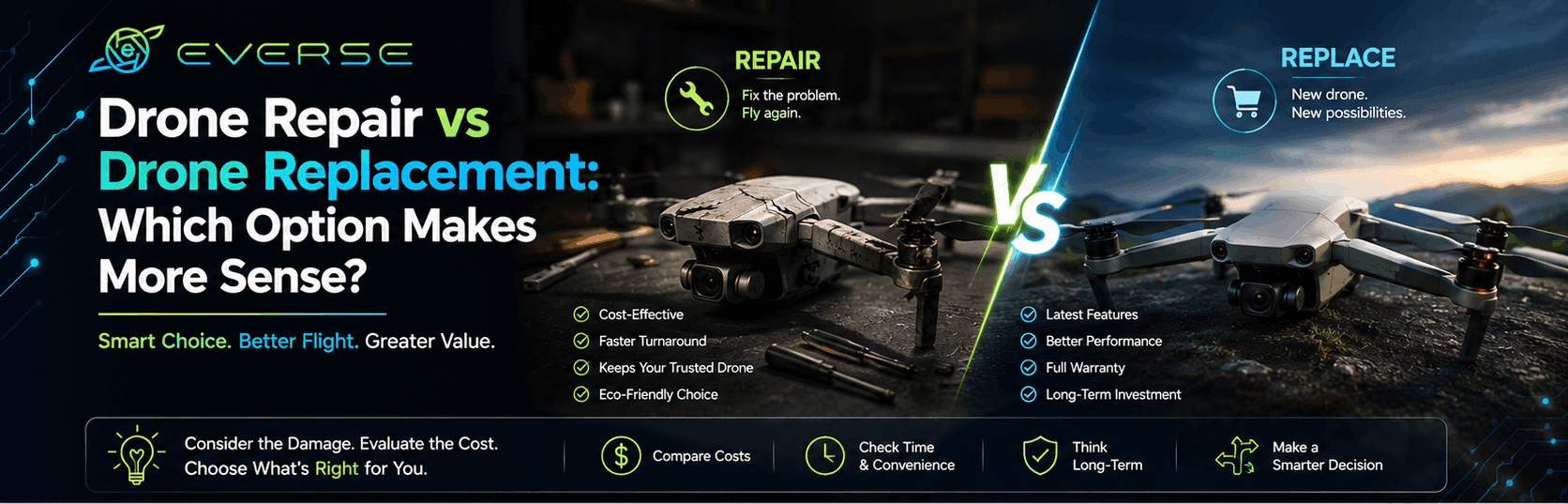
Drone Repair vs Drone Replacement: Which Option Makes More Sense?
A drone crash can be frustrating.
Whether you're a professional surveyor, content creator, agricultural operator, or recreational pilot, seeing your drone hit the ground is never a pleasant experience. Once the initial shock wears off, most drone owners find themselves asking the same question:
Should I repair my drone or replace it altogether?
The answer isn't always straightforward.
While some damages can be repaired quickly and cost-effectively, others may make replacement a more practical long-term decision. Understanding the factors involved can help drone owners make informed choices that save both time and money.
Not every crash results in catastrophic damage.
In many cases, what appears to be a major problem may actually involve relatively simple repairs.
Common repairable issues include:
- Damaged propellers
- Cracked landing gear
- Motor replacement
- Camera gimbal repairs
- GPS module issues
- Battery connector damage
- Sensor calibration problems
These types of repairs are often significantly less expensive than purchasing a new drone.
However, determining the true extent of the damage requires a thorough inspection.
Internal components may be affected even when external damage appears minor.
In many situations, professional repair is the most economical option.
If the affected components represent a small percentage of the drone's overall value, repair is usually the logical choice.
For example, replacing a damaged motor or repairing a gimbal is often far more affordable than investing in an entirely new aircraft.
Newer drones typically have a longer remaining service life.
If the drone has performed reliably and has not experienced repeated issues, repairing it can extend its usefulness for years to come.
Commercial drones used for surveying, mapping, inspections, agriculture, or industrial operations often represent significant investments.
Replacing an entire system may not be necessary if only a specific component requires attention.
Professional repairs can often restore these drones to full operational capability at a fraction of replacement costs.
Repairing a drone can sometimes be faster than sourcing and configuring a replacement model.
For businesses operating on tight project schedules, reducing downtime may be a major factor in the decision-making process.
While repair is often cost-effective, there are situations where replacement becomes the smarter choice.
Severe crashes can damage critical structural components such as:
- Main frames
- Arms
- Flight controllers
- Power distribution systems
When multiple major systems are affected, repair costs can increase significantly.
In some cases, the total repair investment may approach the cost of a new drone.
If a drone has already undergone multiple repairs, additional maintenance expenses may continue to accumulate.
At some point, replacement may provide greater reliability and lower long-term costs.
Drone technology evolves rapidly.
Newer models often offer:
- Better cameras
- Improved flight stability
- Enhanced obstacle avoidance
- Longer flight times
- More advanced safety features
If an older drone requires major repairs, upgrading to a newer platform may provide better overall value.
For commercial operators, reliability is everything.
If there is uncertainty regarding the long-term performance of a heavily damaged drone, replacement may provide greater confidence for mission-critical operations.
The repair-versus-replacement decision shouldn't be based solely on immediate costs.
Other factors may influence the true value of each option.
How long will the drone be unavailable?
For commercial operators, delays can impact project schedules, productivity, and client commitments.
Will the repaired drone continue to perform reliably over time?
A quality repair performed by experienced technicians can restore performance, but extensive damage may affect long-term dependability.
Replacing a drone often involves:
- System setup
- Firmware updates
- Calibration
- Accessory compatibility checks
- Pilot familiarization
These additional requirements should be considered when evaluating replacement costs.
One of the biggest mistakes drone owners make is deciding between repair and replacement before obtaining a professional assessment.
Visible damage rarely tells the full story.
A qualified drone technician can:
- Inspect structural components
- Evaluate electronic systems
- Check motor performance
- Assess battery health
- Verify sensor functionality
- Identify hidden damage
This diagnostic process provides a clearer understanding of repair feasibility and expected costs.
In many cases, owners are surprised to discover that a drone they assumed was beyond repair can actually be restored efficiently.
For organizations that rely on drones for surveying, inspections, agriculture, mapping, or infrastructure projects, equipment represents a significant business investment.
Regular maintenance, timely repairs, and professional inspections help maximize return on that investment.
Rather than viewing repairs as expenses, many successful drone operators view them as part of a broader asset management strategy designed to extend equipment lifespan and maintain operational readiness.
At Everse, we understand how important reliable drone performance is for both recreational and commercial operators.
Our drone repair and maintenance services are designed to help identify issues quickly, restore aircraft performance, and provide honest recommendations regarding repair versus replacement.
Whether you're dealing with crash damage, component failures, battery issues, calibration problems, or general wear and tear, our experienced technicians can help evaluate the condition of your drone and recommend the most practical solution.
There is no universal answer to the repair-versus-replacement question.
The right choice depends on factors such as:
- Extent of damage
- Repair costs
- Drone age
- Operational requirements
- Future reliability expectations
In many cases, professional repairs can restore a drone to excellent working condition while saving significant money.
In other situations, replacement may offer better long-term value.
The key is making an informed decision based on a professional assessment rather than assumptions.
Because whether you choose repair or replacement, the ultimate goal remains the same: keeping your drone safe, reliable, and ready for its next mission.