Drone Crashed? Here's What You Should Do Next
Few moments are more stressful for a drone pilot than watching their drone crash.
Whether it was caused by a sudden obstacle, strong winds, pilot error, battery failure, signal loss, or an unexpected technical issue, the immediate reaction is usually the same: panic.
However, what you do in the minutes and hours following a crash can significantly impact both the safety of the situation and the likelihood of successfully recovering your drone.
The good news is that a crash doesn't always mean the end of your aircraft. Many drones can be repaired and returned to service if the damage is assessed correctly and addressed promptly.
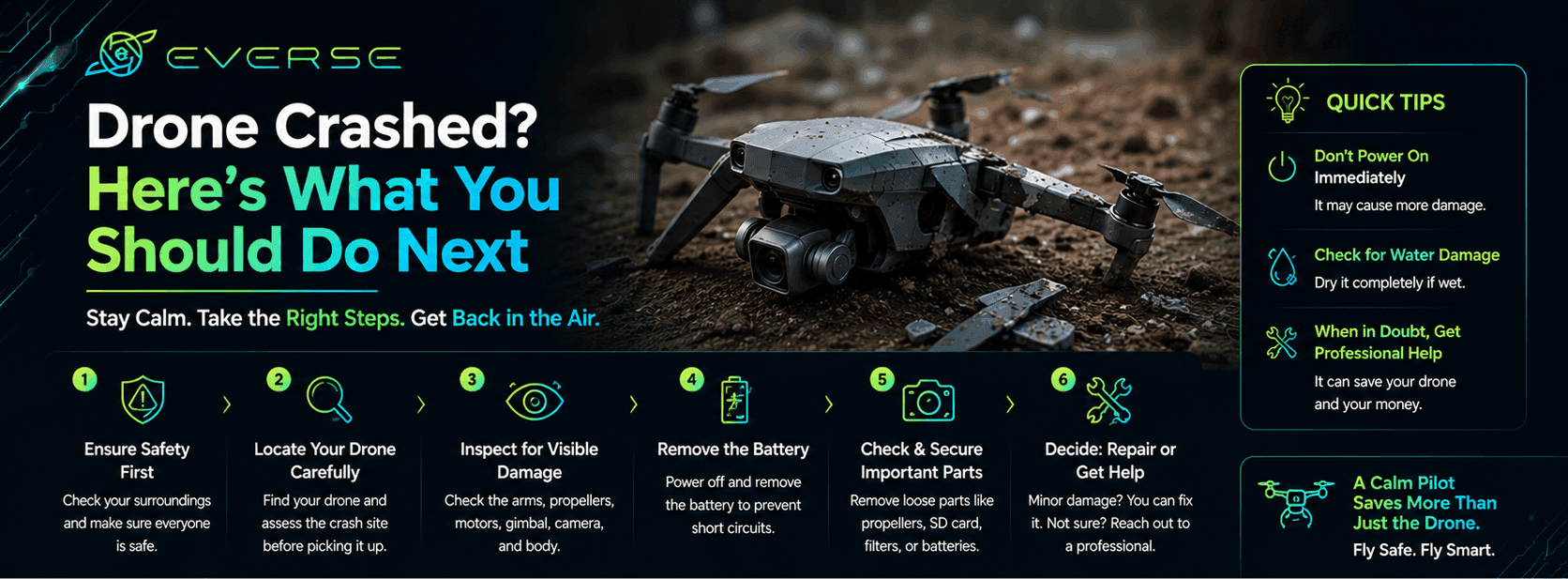
If your drone has crashed, here's what you should do next.
Your first priority should always be safety.
Before rushing toward the drone, take a moment to assess the surrounding environment.
Consider:
- Are there moving vehicles nearby?
- Has the drone landed near power lines?
- Is the area safe to access?
- Are people or property at risk?
If the crash occurred in a hazardous location, approach carefully and follow local safety guidelines.
Remember that damaged batteries and electronic components can sometimes present risks after an impact.
If the drone is still powered on after the crash, switch it off as soon as it is safe to do so.
This helps prevent:
- Further electronic damage
- Motor strain
- Short circuits
- Battery-related issues
If the battery appears swollen, damaged, punctured, or unusually hot, avoid handling it unnecessarily and seek professional assistance.
Battery safety should never be taken lightly.
Once the drone is secured, perform a visual inspection.
Look carefully for:
Even small cracks or chips can affect flight stability and safety.
Damaged propellers should always be replaced before flying again.
Check the arms, landing gear, and body for:
- Cracks
- Bends
- Loose components
- Structural damage
Small fractures can become major failures during future flights.
Inspect the camera system for:
- Misalignment
- Physical damage
- Restricted movement
- Broken mounts
Gimbal systems are particularly vulnerable during impacts.
Examine motors for:
- Dirt or debris
- Physical damage
- Unusual resistance
- Bent shafts
Motors should rotate smoothly without grinding or excessive friction.
The battery often absorbs a significant portion of impact forces during a crash.
Inspect it for:
- Swelling
- Cracks
- Dents
- Loose connectors
- Leakage
If anything appears unusual, discontinue use immediately.
Using a damaged battery can increase the risk of failure during future flights.
When in doubt, have the battery evaluated by qualified technicians.
Modern drones record valuable flight information.
Reviewing flight logs can help identify what caused the incident.
Potential causes may include:
- Low battery conditions
- GPS loss
- Compass errors
- Signal interference
- Obstacle collisions
- Pilot input mistakes
- Environmental factors
Understanding the root cause helps prevent similar incidents in the future.
For commercial operators, maintaining records of incidents is also considered a good operational practice.
Many drone owners make the mistake of conducting a quick visual inspection and immediately attempting another flight.
This can be risky.
Some damage is not visible externally.
Hidden issues may involve:
- Flight controllers
- GPS modules
- Internal wiring
- Sensors
- Motor assemblies
- Electronic speed controllers (ESCs)
Flying a damaged drone can lead to further failures and potentially more severe crashes.
A careful assessment is always worth the extra time.
Even if the drone appears functional, professional diagnostics can reveal hidden problems that might otherwise go unnoticed.
Qualified technicians can evaluate:
- Structural integrity
- Motor performance
- Sensor accuracy
- Battery health
- Internal electronics
- Flight control systems
This is especially important for drones used in surveying, inspections, mapping, agriculture, filmmaking, and other commercial applications where reliability is critical.
In many cases, yes.
Some of the most common repairable crash-related issues include:
- Propeller replacement
- Motor repairs
- Gimbal restoration
- Frame repairs
- Sensor calibration
- Battery replacement
- Landing gear repairs
The extent of the damage ultimately determines whether repair or replacement makes the most sense.
Fortunately, many drones that initially appear severely damaged can often be restored through professional repair services.
While no pilot can eliminate all risks, several best practices can significantly reduce the likelihood of future incidents.
Check batteries, propellers, motors, and sensors before every mission.
Strong winds, rain, and poor visibility can create hazardous flying conditions.
Software updates often improve stability, performance, and safety.
Avoid pushing the drone beyond recommended performance limits.
Routine maintenance helps identify issues before they become flight risks.
At Everse, we understand how frustrating a drone crash can be.
Our drone repair and maintenance services are designed to help drone owners quickly assess damage, identify underlying issues, and restore their equipment to safe operating condition.
Whether your drone has experienced minor impact damage or requires extensive repairs, our technicians can provide professional diagnostics and recommend the most practical solution.
A drone crash can feel like a major setback, but it doesn't necessarily mean your aircraft is beyond recovery.
By staying calm, prioritizing safety, conducting a careful inspection, and seeking professional assistance when needed, many drone owners can successfully return their equipment to service.
The most important thing is resisting the urge to rush back into the air before understanding the full extent of the damage.
Because when it comes to drone safety, a thorough inspection today can prevent a much bigger problem tomorrow.