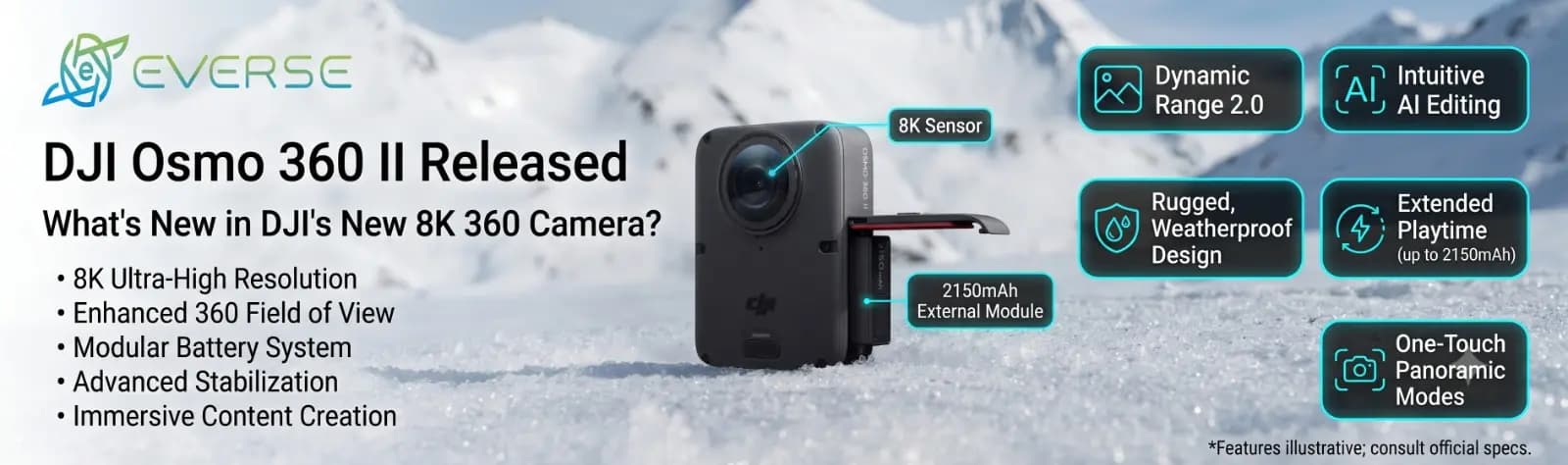
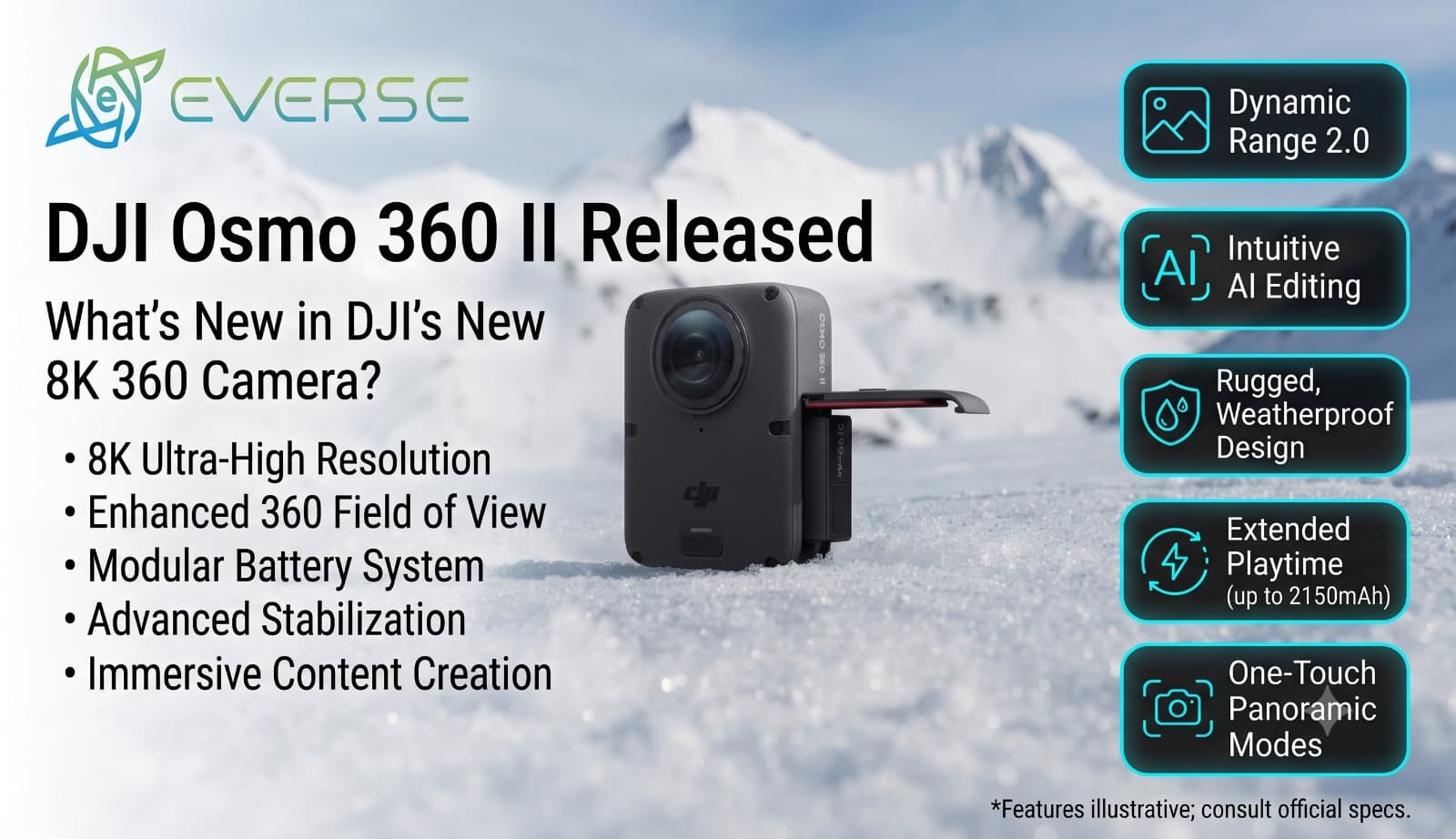
DJI Osmo 360 II Released: What's New in DJI's New 8K 360 Camera
DJI has officially launched the Osmo 360 II, its latest flagship 360-degree camera, bringing higher frame rates, improved low-light performance, replaceable lenses and new AI-powered features to its panoramic camera lineup.
The global launch took place on September 3, 2026, ahead of the camera's public appearance at IFA 2026 in Berlin. DJI describes the Osmo 360 II as the next generation of its 360 imaging technology, building on more than 12 years of experience in handheld imaging. DJI's official Osmo 360 II launch announcement
The biggest change is the ability to record native 8K 360-degree video at 60fps.
The previous Osmo 360 supported 8K at up to 50fps. The additional frame rate should be particularly useful for action footage such as motorcycle rides, cycling, skiing and other fast-moving scenes.
DJI says the Osmo 360 II uses a 1-inch square HDR sensor, with 2.4μm pixels and a claimed 14.5 stops of dynamic range. According to DJI, the square sensor design increases sensor utilization by 25% while maintaining the required 360-degree field of view.
Low-light shooting is another major focus.
The Osmo 360 II introduces AI SuperNight 2.0, which combines the camera's large pixels, f/1.9 aperture and AI-based noise reduction to produce cleaner footage in darker environments.
This could make the camera more useful for night rides, city walks, concerts, travel videos and other situations where conventional 360 cameras can struggle with noise.
One of the most useful changes isn't related to resolution at all.
DJI has introduced ultra-hard, replaceable lenses on the Osmo 360 II. If a lens becomes scratched or damaged, it can be replaced instead of potentially turning the camera into an expensive repair job.
For an action camera frequently mounted on motorcycles, bicycles, helmets or selfie sticks, this is a significant improvement.
DJI says both lenses also feature an ultra-hard optical film designed to improve resistance to scratches and wear.
The Osmo 360 II can capture 120MP HDR 360-degree photographs, while a new 16K 360-degree timelapse mode gives creators considerably more resolution when compressing long scenes into short videos.
DJI has also added creative features including 64x Pano Slow Motion through AI frame interpolation and an 8K/120fps Vortex mode. All video formats support 10-bit colour and D-Log M, giving more flexibility for colour grading.
Another new feature is Spotlight Follow.
Instead of manually reframing the footage later, the camera can identify a subject and keep it centred even as the camera rotates.
For solo creators, this could make 360-degree filming considerably easier because the camera can help determine which subject should remain the focus.
The Osmo 360 II also gets NFC Quick Connect, allowing users to quickly connect the camera to the DJI Mimo app for transferring footage and accessing editing functions.
The camera weighs approximately 183g and includes 128GB of internal storage, with 105GB available for use.
That is particularly useful for 8K 360 video, where large files can quickly consume a memory card.
DJI also claims up to 100 minutes of continuous recording at 8K/30fps and says the battery can reach 80% charge in approximately 22 minutes. With the optional Battery Extension Rod, DJI claims up to 180 minutes of additional runtime.
It is worth noting that the 100-minute figure is specifically an 8K/30fps claim, not an 8K/60fps battery-life figure.
DJI is positioning the Osmo 360 II for several types of creators.
The camera can be used underwater to 10 metres without a case, while DJI's Invisible Waterproof Case extends this to 50 metres. It can also operate in temperatures as low as -20°C, making it suitable for skiing and other cold-weather activities.
For vloggers, DJI continues to promote its Invisible Selfie Stick, which can be removed automatically from the final 360-degree footage to create the appearance of a floating camera.
The Osmo 360 II includes a four-microphone array and wind-noise reduction.
More importantly, it supports DJI OsmoAudio direct microphone connectivity with products such as the DJI Mic 3, DJI Mic 2 and DJI Mic Mini series.
This gives creators using DJI's existing audio ecosystem a more integrated recording setup.
DJI's own launch announcement positions the camera as more than simply an 8K upgrade. The company says the Osmo 360 II combines its experience in aerial imaging, Ronin stabilization and Osmo Action colour science.
The company also highlights the camera's ability to capture everything around the user and allow the final perspective to be selected later — one of the biggest advantages of shooting in 360 degrees.
You can read the complete announcement directly on DJI's official website: DJI — Osmo 360 II Official Launch Announcement
DJI had also announced the camera's upcoming IFA appearance a week earlier, describing it as its flagship 360-degree camera capable of up to 8K/60fps panoramic video. DJI — IFA 2026 Osmo 360 II Announcement
| Feature | Osmo 360 | Osmo 360 II |
|---|---|---|
| Maximum 360 Video | 8K/50fps | 8K/60fps |
| Dynamic Range | 13.5 stops | 14.5 stops |
| 360° Photos | 120MP | 120MP HDR |
| Night Mode | SuperNight | AI SuperNight 2.0 |
| Lens | Fixed | Replaceable |
| Subject Tracking | Not available | Spotlight Follow |
| Timelapse | Not available | 16K |
| Built-in Storage | 105GB available | 105GB available |
| Weight | 183g | 183g |
For someone buying their first 360 camera, the Osmo 360 II offers a very complete package: 8K/60fps recording, 14.5-stop dynamic range, AI SuperNight 2.0, 120MP HDR photos, replaceable lenses, AI subject tracking and built-in storage.
For existing Osmo 360 owners, the upgrade is more evolutionary than revolutionary. The basic design and sensor size remain familiar, but the improvements to frame rate, low-light performance, lens durability and workflow make the second generation more practical for demanding users.
The biggest takeaway is that DJI has not simply increased the resolution. It has focused on the parts of a 360 camera that matter after the specification sheet — durability, low-light shooting, storage, tracking and ease of use.
For travellers, motorcyclists, cyclists, adventure creators and vloggers who want to capture an entire scene and decide the framing later, the DJI Osmo 360 II is shaping up to be one of DJI's most capable creator cameras yet.