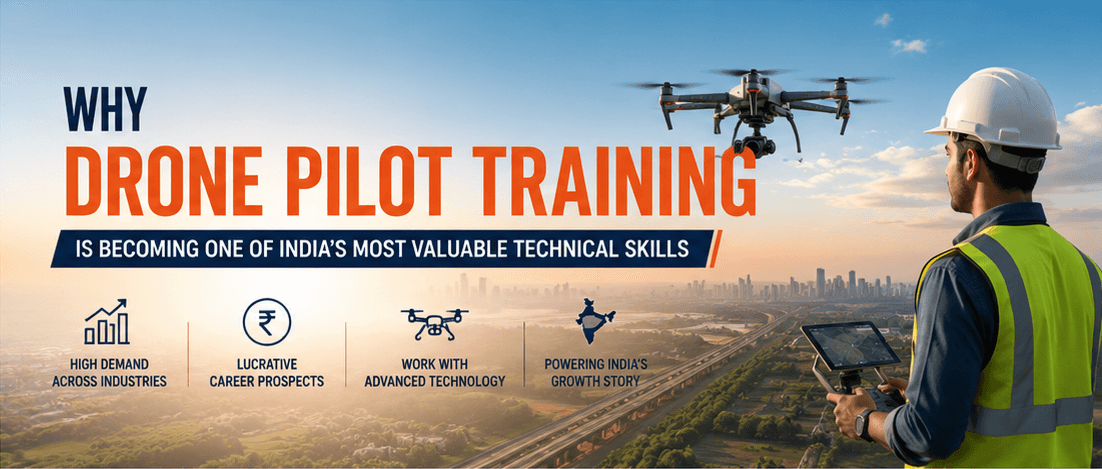
Why Drone Pilot Training Is Becoming One of India's Most Valuable Technical Skills
A few years ago, most people thought of drones as gadgets used for wedding shoots, travel videos, or hobby flying. Today, that perception has changed dramatically.
Drones are now helping survey vast mining sites, inspect solar power plants, monitor agricultural fields, map highways, assess construction progress, and even support disaster response operations. What once seemed like futuristic technology has quickly become an essential business tool across multiple industries.
As drone adoption accelerates across India, one challenge is becoming increasingly evident: there is a growing need for trained and certified drone pilots who can operate these systems safely, efficiently, and legally.
This shift is creating exciting opportunities for students, working professionals, entrepreneurs, engineers, surveyors, and technology enthusiasts who are willing to invest in the right skills.
The Indian drone ecosystem has undergone a remarkable transformation in recent years. Supportive government policies, advancements in drone technology, and increasing industry adoption have turned drones from niche tools into mainstream business assets.
Today, organizations across sectors are integrating drones into their daily operations because they help businesses:
- Complete surveys significantly faster than traditional methods
- Reduce manpower requirements for large-scale inspections
- Improve safety in hazardous environments
- Collect highly accurate aerial data
- Monitor assets and projects in real time
- Lower operational costs
Whether it's a solar farm spread across hundreds of acres or a construction project involving multiple stakeholders, drones are enabling faster decision-making and better project visibility.
However, sophisticated drone technology is only as effective as the person operating it.
This is where professional drone pilot training becomes essential.
Many people assume that if they can fly a consumer drone, they can immediately start working as a drone pilot. In reality, professional drone operations involve much more than basic flight controls.
A certified drone pilot must understand:
- Airspace regulations and flight permissions
- DGCA compliance requirements
- Mission planning and risk assessment
- Weather conditions and their impact on flight operations
- Emergency procedures
- Safety protocols
- Equipment checks and maintenance practices
- Data collection standards
In professional environments, a drone pilot isn't simply flying an aircraft. They are responsible for ensuring safe operations, protecting people and property, and delivering reliable results for clients or employers.
That responsibility requires proper training.
One of the biggest misconceptions about drone pilot certification is that it is entirely focused on flying.
In reality, a quality training program combines theoretical knowledge with practical flight experience.
Before operating a drone professionally, pilots need to understand the regulatory framework governing drone operations in India.
Training typically covers:
- Drone regulations and compliance requirements
- Airspace classification
- Aviation fundamentals
- Flight planning
- Safety procedures
- Emergency response protocols
These concepts form the foundation of responsible drone operations.
Before handling an actual aircraft, trainees often practice using flight simulators.
This stage helps participants become familiar with drone controls, navigation, and emergency scenarios in a controlled environment. It allows learners to make mistakes, learn from them, and build confidence before moving to live operations.
This is where theory becomes practical experience.
Under instructor supervision, trainees learn how to:
- Conduct pre-flight inspections
- Prepare a drone for operations
- Execute safe takeoffs and landings
- Perform controlled maneuvers
- Manage flight missions
- Respond to unexpected situations
- Follow operational best practices
For many participants, this is the moment when they begin to see drones not as gadgets, but as professional tools capable of solving real-world challenges.
When people hear "drone pilot," aerial photography is often the first thing that comes to mind.
While photography and videography remain important applications, they represent only a small portion of the opportunities available today.
Engineering firms, infrastructure companies, and geospatial organizations increasingly rely on drones for topographic surveys, corridor mapping, and land assessments.
Modern farming is becoming more data-driven. Drones help monitor crop health, identify field issues, and support precision agriculture practices that improve productivity.
Project managers use drones to monitor site progress, track timelines, generate reports, and improve communication between stakeholders.
Drones enable faster stockpile measurements, site analysis, and operational planning while improving worker safety.
Solar plants, transmission lines, and industrial facilities often require regular inspections. Drones make these inspections faster, safer, and more cost-effective.
Government agencies and emergency teams use drones for disaster assessment, search and rescue operations, surveillance, and incident monitoring.
As more industries discover practical uses for drone technology, the demand for skilled operators continues to rise.
In a rapidly growing industry, certification provides credibility.
Employers and clients want confidence that a drone pilot understands regulations, follows safety procedures, and can operate responsibly.
A DGCA-approved certification demonstrates that a pilot has undergone structured training and meets the standards expected for professional operations.
For individuals looking to build a long-term career in the drone sector, certification is often one of the most valuable investments they can make.
At Everse, we understand that drone training should go beyond helping participants pass an assessment.
Our goal is to prepare individuals for real-world drone operations and the opportunities emerging across India's rapidly evolving drone ecosystem.
Our 5-Day DGCA Approved Drone Pilot Training Program combines:
- DGCA-compliant theoretical instruction
- Practical flight training
- Simulator-based learning
- Industry-focused operational knowledge
- Safety and compliance best practices
- Guidance from experienced instructors
Whether you're a student exploring future career opportunities, a working professional looking to upskill, or a business owner planning to integrate drone technology into your operations, the program is designed to provide both confidence and competence.
Every major technological shift creates new opportunities for those who develop the right skills early.
The rise of drones is no different.
As industries continue to adopt drone-based workflows, certified drone pilots will play a critical role in collecting data, improving operational efficiency, enhancing safety, and supporting decision-making across sectors.
The question is no longer whether drones will become part of mainstream industry.
That transition is already happening.
The real question is whether you will be prepared to take advantage of the opportunities it creates.
For those looking to enter one of India's most promising technology-driven fields, professional drone pilot training is an excellent place to start.
And with Everse's 5-Day DGCA Approved Drone Pilot Training Program, that journey can begin today.