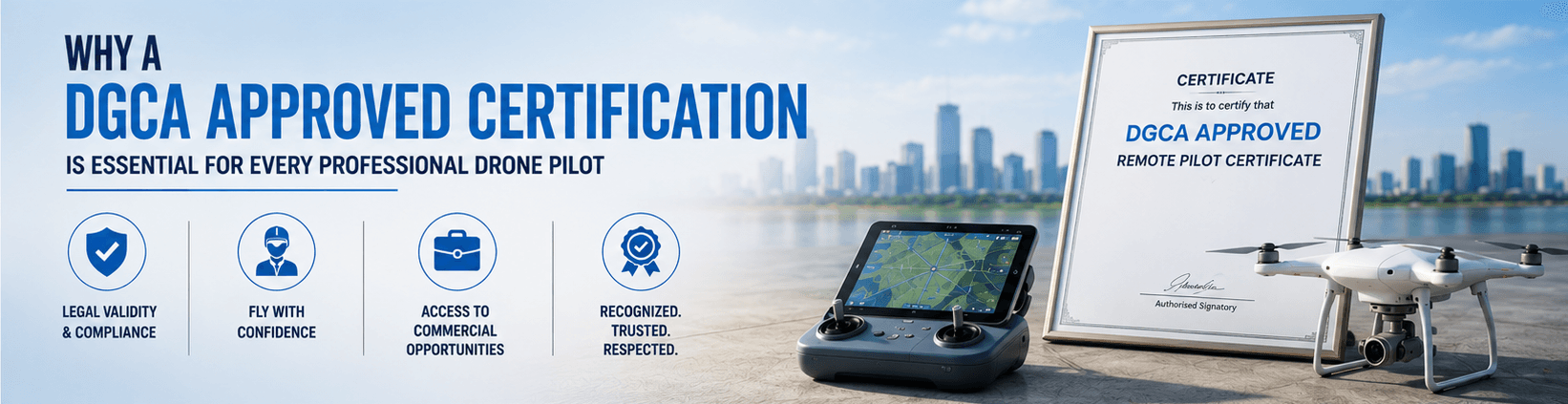
Why a DGCA Approved Certification Is Essential for Every Professional Drone Pilot
The drone industry in India is growing at a remarkable pace.
What was once considered a niche technology is now helping businesses survey land, inspect infrastructure, monitor crops, manage construction projects, and collect valuable data faster than ever before. As industries increasingly adopt drone technology, the demand for skilled drone pilots continues to rise.
However, owning a drone and flying a drone professionally are two very different things.
Just as a driver's license demonstrates that an individual understands road safety and traffic regulations, a DGCA approved drone pilot certification shows that a pilot has received formal training and understands how to operate drones safely, responsibly, and legally.
For anyone considering a career in the drone industry, obtaining a DGCA approved certification is no longer just an advantage—it has become an important step toward professional credibility and long-term career growth.
The Directorate General of Civil Aviation (DGCA) is India's aviation regulatory authority responsible for overseeing civil aviation activities, including drone operations.
A DGCA approved drone pilot certification is awarded to individuals who successfully complete training through an authorized training organization and demonstrate the knowledge and practical skills required to operate drones professionally.
The certification process ensures that drone pilots understand:
- Aviation regulations
- Airspace restrictions
- Flight safety procedures
- Emergency response protocols
- Mission planning
- Drone operation and maintenance
- Risk assessment and compliance requirements
Rather than focusing solely on flying skills, the certification aims to create responsible operators capable of conducting safe and compliant drone missions.
As drones become increasingly integrated into commercial operations, organizations are looking for professionals who can operate them safely and efficiently.
Certification provides confidence that a pilot understands both the technology and the responsibilities that come with it.
When employers, clients, or project stakeholders hire a drone pilot, they want assurance that the operator has received structured training.
A DGCA approved certification demonstrates that the pilot has met recognized industry standards and understands the regulations governing drone operations in India.
Drone operations are regulated for safety reasons. Professional projects often require pilots to follow specific operational guidelines and procedures.
Training helps pilots understand how to remain compliant while conducting missions across different environments and use cases.
Professional drone operations often take place near infrastructure, construction sites, industrial facilities, agricultural land, or populated areas.
Certification programs place significant emphasis on risk assessment, operational planning, and emergency procedures to minimize potential hazards.
As businesses continue to adopt drone technology, certified pilots are becoming increasingly valuable.
Employers often prefer candidates who possess formal training because certification demonstrates professionalism, competence, and commitment to industry standards.
Many people assume drone training is simply about learning how to control an aircraft.
In reality, the curriculum covers much more.
Theoretical sessions introduce trainees to key concepts such as:
- Drone regulations and policies
- Principles of flight
- Aviation meteorology
- Airspace awareness
- Flight planning
- Safety management
- Operational procedures
These topics help pilots understand the environment in which drones operate.
Before flying a real drone, trainees often practice using advanced flight simulators.
Simulator training allows participants to develop confidence, understand controls, and learn how to respond to unexpected situations without risk.
Hands-on flying sessions help trainees apply classroom knowledge in real-world scenarios.
Participants learn:
- Pre-flight inspections
- Aircraft preparation
- Safe takeoffs and landings
- Navigation techniques
- Emergency handling procedures
- Post-flight maintenance practices
This practical experience is critical for building competence and confidence.
One of the biggest misconceptions about drone careers is that they are limited to photography and videography.
In reality, certified drone pilots are finding opportunities across a wide range of industries.
Drone-based surveys help organizations collect accurate geographical and topographical data in a fraction of the time required by traditional methods.
Farmers and agribusinesses use drones for crop monitoring, field assessment, and precision agriculture applications.
Project teams rely on drones to track progress, monitor sites, and improve project documentation.
Drones are increasingly used to inspect roads, bridges, power lines, solar plants, and industrial assets safely and efficiently.
Mining operations use drones for stockpile measurements, site planning, and operational monitoring.Mining operations use drones for stockpile measurements, site planning, and operational monitoring.
Government agencies and emergency response teams use drones for disaster assessment, surveillance, and search-and-rescue operations.
As drone adoption continues to expand, certified pilots will play a critical role in supporting these industries.
At Everse, we believe drone training should prepare participants for real-world opportunities, not just certification requirements.
Our 5-Day DGCA Approved Drone Pilot Training Program combines theoretical learning, simulator practice, and practical flight training to help aspiring pilots develop the skills required for professional drone operations.
Participants gain exposure to:
- DGCA-compliant training modules
- Experienced instructors
- Practical flying sessions
- Operational safety procedures
- Mission planning techniques
- Industry-relevant knowledge
Whether you're a student, working professional, entrepreneur, engineer, or technology enthusiast, the program is designed to help you build a strong foundation for a future in the drone industry.
The drone industry is creating opportunities across sectors that were unimaginable just a decade ago.
From infrastructure development and agriculture to smart cities and industrial inspections, drones are becoming an integral part of modern operations.
As this transformation continues, certified drone pilots will remain at the center of it.
A DGCA approved certification is more than a qualification. It is proof that you possess the knowledge, skills, and professionalism required to operate in one of India's fastest-growing technology sectors.
For anyone serious about building a career in drone technology, obtaining a DGCA approved drone pilot certification is one of the smartest investments they can make in their future.